
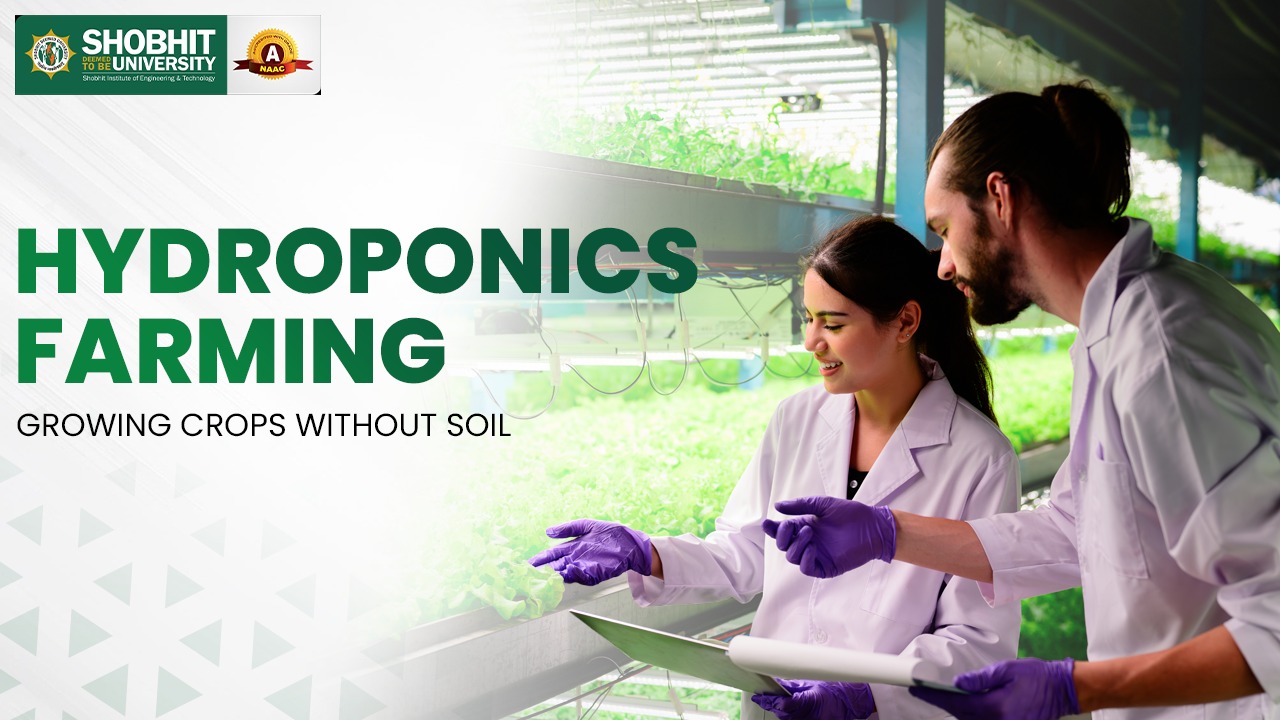
Hydroponics Farming: Growing Crops Without Soil
Agriculture is consistently observing new evolutions. Today, we are discussing one such innovation: hydroponic farming. We’ve all known the issues the agricultural industry faces, such as limited land, water scarcity, and climate change. These reasons make traditional soil-based farming unsustainable in the long term. However, hydroponic farming provides a way out—a way to farm without soil. By using nutrient-rich water solutions and controlled environments, hydroponics is transforming modern agriculture and becoming a key part of smart farming technology. This blog explains what hydroponic farming is, how it works, its benefits, and the business prospects in India.
What Is Hydroponic Farming?
Hydroponic farming is a type of agriculture in which soil is completely removed from the growing process. The technique uses nutrient-rich water solutions—plants are planted in these, from where they receive all the essential minerals. It’s like farmers have a remote control that lets them manage every aspect of plant growth, leading to faster, more efficient farming.
How Does Hydroponics Work?
Though multiple techniques enable hydroponics, the overall process remains similar. It involves:
- Providing the plant with a balanced nutrient solution
- Maintaining oxygen levels for roots
- Controlling light, temperature, and humidity
- Using support structures instead of soil
The various types of hydroponic systems include:
- Nutrient Film Technique (NFT): A thin stream of nutrient solution continuously flows over the plants.
- Deep Water Culture (DWC): Plants are grown directly in nutrient-rich water solutions.
- Drip System: Nutrients are passed drop by drop across plants.
- Aeroponics (Advanced): Roots are suspended in the air, and nutrients are distributed through mist.
Benefits of Hydroponic Farming
Hydroponic farming benefits include:
- Space optimisation: Soil-based farming limits the area available for crop planting. Hydroponic technologies maximise the use of limited spaces.
- Resource management: Since crops are grown under complete nutrient control, water and fertilisers can be managed and utilised accordingly.
- Protection for sensitive species: Controlled crop growth helps protect against climatic extremes, pests, and diseases.
- Environmental benefits: Hydroponics uses 90% less water than traditional crop systems. Pollutants are also reduced. Land can be put to different uses, and soil-based diseases are eradicated.
- Higher yields & faster growth: Hydroponic farming is highly flexible and increases yields by 20-30% in a shorter time frame.
- Year-round production: Seasonal farming is eliminated using hydroponics. Using controlled environments, all types of crops can be grown throughout the year.
Which Plants Grow in Hydroponics?
Theoretically, all crops can be grown in a hydroponic setting. But market forces choose limited crops. It is exactly the reason you will see modern B. Tech. in Agricultural Engineering programs cover market factors alongside crop suitability.
| Leafy Greens | Vegetable Crops | Culinary Herbs |
|---|---|---|
| Lettuce | Tomatoes | Basil |
| Spinach | Peppers | Mint |
| Kale | Cucumbers | Cilantro |
| Rosemary | ||
| Parsley | ||
Hydroponics vs Soil Farming
| Factor | Hydroponics | Soil Farming |
|---|---|---|
| Water Usage | Low | High |
| Growth Speed | Faster | Normal |
| Land Requirement | Minimal | High |
| Pest Issues | Lower | Higher |
| Nutrient Control | High | Limited |
Hydroponic Farming Business
Hydroponics is largely a business-focused farming technique. Lately, hydroponic farming in India has gained popularity, and there is a massive business opportunity. However, ensure the following considerations:
- Initial setup cost (equipment, infrastructure)
- Technical knowledge
- Market access
- Crop selection
Is Hydroponic Farming Profitable?
The business looks simple:
- Setting up controlled farming systems
- Producing high-quality vegetables
- Supplying to urban markets, restaurants, and retailers
Though profitability depends on various factors, hydroponics can deliver high yields per unit area and allow you to charge higher prices with lower resource costs. Still, investments and technical knowledge need to be considered. In short, you would need proper planning and an excellent market strategy for a hydroponics business to be profitable.
Conclusion
Hydroponic farming changes how we’ve grown crops for centuries. It eliminates soil (and the challenges it brings) from farming and enables crop growth with more efficient, controlled, and sustainable nutrient-rich water solutions. Considering the current landscape, hydroponics is going to be the next big thing in agriculture.
Educational institutions are already catching up with this change. For example, Shobhit University, the best university in Delhi NCR, has made the necessary curriculum changes, and its expert faculty is constantly updated on the latest trends to provide students with insights into future farming.
