
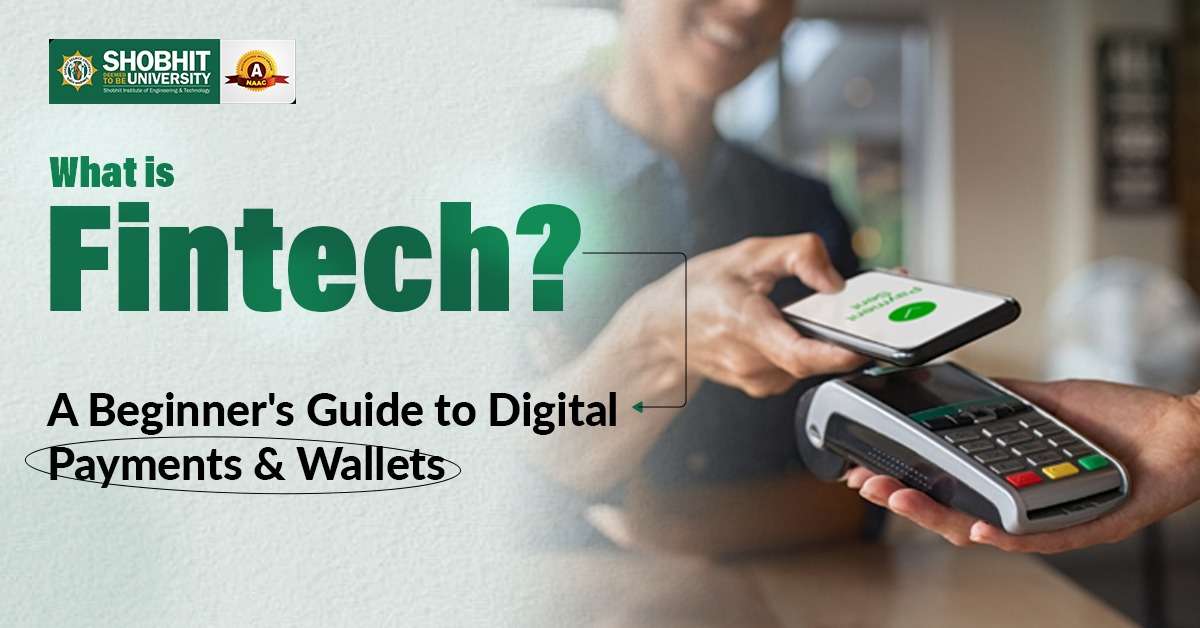
What is Fintech? A Beginner's Guide to Digital Payments and Wallets
The financial services industry has undergone a remarkable transformation with the rapid adoption of digital technologies. Today, services such as mobile banking, digital wallets, online lending, and UPI payments have made financial transactions faster, more secure, and easily accessible. This evolution, commonly known as Financial Technology (FinTech), is reshaping the way individuals and businesses manage, transfer, and invest money. In this article, we explore the fundamentals of FinTech, understand digital payment systems, and discuss the career opportunities emerging in this fast-growing industry.
What is FinTech? Why FinTech Matters Today?
FinTech has become an integral part of the modern financial ecosystem by making financial services more accessible, efficient, and customer-centric. Governments, financial institutions, start-ups, and technology companies are increasingly adopting digital financial solutions to improve financial inclusion, reduce transaction costs, strengthen security, and enhance customer experience.
Financial technology, often abbreviated as fintech, is the use of technology to provide financial services. In simple terms, FinTech refers to the use of innovative technologies to deliver financial services more efficiently, securely, and conveniently, and to enhance customer experience, improve operational efficiency, and make financial services more accessible.
FinTech has transformed traditional financial services by enabling faster transactions, improved accessibility, and technology-driven financial solutions. FinTech combines finance with emerging technologies such as Artificial Intelligence (AI), blockchain, cloud computing, data analytics, cybersecurity, and mobile applications to create innovative financial solutions.
FinTech services include:
- Mobile banking
- Online lending platforms
- Digital payment systems
- Robo-advisors
- Blockchain-based applications (like cryptocurrencies)
What are Digital Payments?
Digital payments refer to financial transactions executed electronically or digitally without the involvement of physical cash. One of the most common examples of digital payments in India is the Unified Payments Interface (UPI), which enables secure and instant bank-to-bank transactions. Today, UPI has become one of the most widely used digital payment systems in India, enabling millions of transactions every day. Popular UPI-enabled payment applications use UPI to facilitate secure digital transactions for individuals and businesses. Other examples of digital payments include:
- Debit and credit card payments
- Internet banking
- Mobile wallets
- QR code payments
- Payment gateways
How Digital Payments Work?
While digital payments feel instant, they go through a multi-step process-all within split seconds, with multiple operations going on in the background. The following steps provide a simplified overview of how a typical digital payment transaction is processed:
- The user initiates the payment through a digital payment processor.
- The payment request is communicated to the sender’s bank.
- The bank verifies essential details: account details, balance, and authentication.
- After approval, payment is successfully processed through the banking network.
- The funds are transferred to the receiver’s account.
- Both sender and receiver are informed about the transaction.
In practice, additional security measures such as encryption, authentication protocols, PIN verification, and one-time passwords (OTPs) ensure secure and reliable transactions. Due to the high risk involved in these processes, they tend to get even more complicated when scrutinized more closely.
In India, digital payment systems operate within a robust regulatory framework established by the Reserve Bank of India (RBI), ensuring secure, reliable, and efficient financial transactions.
Types of Digital Payments
Today, consumers have multiple payment channels they can use based on convenience and transaction requirements.
UPI Payments
As we discussed, UPI makes bank-to-bank transactions possible in seconds using simple mobile payment apps. The main features of UPI are:
- Instant payments
- QR code scanning
- 24x7 availability
- Direct bank account transfers
Mobile Wallet (E-Wallet)
A mobile wallet, commonly known as an e-wallet, is a digital application that allows users to store money electronically and make secure cashless transactions. By removing some steps from the conventional process, transactions from such wallets become extremely quick. For convenience, digital wallet apps can also be linked to your bank accounts. Similar to a physical wallet, an e-wallet enables users to store funds digitally while offering the convenience of quick and secure payments. People use it for:
- Utility bill payments
- Online shopping
- Mobile recharges
- Ticket bookings
- Merchant payments
Internet Banking
Internet banking allows users to visit secure banking websites, access services, and frequently initiate transactions from official portals. Net banking is how you access systems like NEFT and RTGS. It provides you with the ability to:
- Transfer money
- Pay bills
- View account statements
- Manage deposits
- Request banking services
Debit & Credit Cards
Debit and credit cards remain among the most widely used and reliable digital payment methods for both online and offline transactions. You can use the details issued by your bank. Cardholders can use it for:
- Online purchases
- Point-of-sale transactions
- Contactless payments
- International payments
QR Code Payments
QR code payments enable users to make instant transactions by scanning a merchant's QR code through a UPI-enabled payment application. Basically, you are scanning a QR code that links to the receiver’s merchant's ID for receiving payments. This payment method has gained widespread acceptance in India due to its speed, simplicity, and convenience.
Payment Gateways
Payment gateways are platform-specific services used by businesses to bridge transactions between the consumer and the business. They are mainly used in:
- E-commerce
- Subscription services
- Online businesses
- Digital marketplaces
Benefits of Digital Payments
- Convenience: Users can conveniently complete financial transactions anytime and from virtually anywhere.
- Speed: It takes only seconds for the money to reach the receiver’s bank account.
- Security: These payment methods are secured by end-to-end encryption, making it safer than cash.
- Improved Financial Tracking: Users can track what they are spending their money on.
- Reduced Cash Dependency: Digital payments have significantly reduced dependence on physical cash for everyday transactions.
- Rewards & Cashback: Digital payment apps offer multiple offers and incentives.
- Financial Inclusion: Millions of users now have easier access to banking and financial services through digital platforms.
Staying Safe During Online Transactions
As much as online transactions are convenient and secure, they are prone to some risks, and users should follow good cybersecurity practices.
- Never share your OTP or PIN.
- Use trusted payment applications.
- Enable two-factor authentication.
- Avoid making transactions over unsecured public Wi-Fi.
- Regularly monitor your bank statements for transaction mismatches.
- Update your banking and payment apps frequently for any security updates.
- Verify the authenticity of websites and payment links before initiating any transaction.
- Avoid sharing confidential banking information through calls or messages.
The Future of Fintech
As digital adoption continues to accelerate, the FinTech industry is expected to witness significant growth in the coming years. Emerging technologies such as Artificial Intelligence (AI), blockchain, embedded finance, open banking, and advanced data analytics are transforming financial services and creating new opportunities for innovation.
As emerging technologies continue to reshape the financial sector, professionals with expertise in digital finance, analytics, artificial intelligence, blockchain, cybersecurity, and regulatory compliance will be increasingly sought after. Industry-oriented Fintech courses are expected to play an important role in preparing professionals for the rapidly evolving digital financial ecosystem.
Why Study FinTech?
Studying FinTech offers several advantages:
- Access to one of the fastest-growing sectors in the global economy
- Strong demand for professionals with finance and technology expertise
- Opportunities to work across banking, insurance, investment, payments, and digital lending
- Exposure to emerging technologies like Artificial Intelligence, Blockchain, and Data Analytics
- Competitive salaries and long-term career growth
- Opportunities to innovate and build digital financial solutions
Key Technologies Driving FinTech
FinTech is based upon a collection of emerging technologies that make instant and digital payments possible.
- Artificial Intelligence (AI)
- Blockchain Technology
- Cloud Computing
- Big Data & Analytics
- Cybersecurity
- Internet of Things (IoT)
Essential Skills Required for a Career in FinTech
A successful career in FinTech requires a combination of technical knowledge, business understanding, and problem-solving abilities.
Some of the most valuable skills include:
- Financial and business management fundamentals
- Analytical and critical thinking
- Data analysis and interpretation
- Digital literacy and technology awareness
- Understanding of AI, Blockchain, and emerging financial technologies
- Communication and presentation skills
- Problem-solving and decision-making abilities
- Knowledge of cybersecurity and digital payment systems
- Adaptability to rapidly changing technologies
Industries Hiring FinTech Professionals
Fintech is no longer restricted to the finance industry, and organizations across various sectors actively recruit fintech professionals.
- Commercial and private banks
- FinTech startups
- Digital payment companies
- Insurance (InsurTech) firms
- Investment and wealth management companies
- E-commerce and online retail platforms
- NBFCs (Non-Banking Financial Companies)
- Financial consulting firms
- Stock exchanges and brokerage companies
- Regulatory technology (RegTech) organizations
Fintech Career Opportunities
The rapid growth of digital financial services has created diverse career opportunities across banking, financial services, technology, consulting, and regulatory organizations. Fintech growth has created some exciting career opportunities across the banking, technology, consulting, and financial services industries. Popular options are:
- Fintech Analyst
- Business Analyst
- Digital Banking Specialist
- Product Manager
- Risk & Compliance Executive
- Financial Data Analyst
- Blockchain Analyst
- Digital Payments Specialist
- Fraud Risk Analyst
- Compliance Officer
- Product Owner (FinTech)
Fintech Career Options After 12th
Although there is no single academic pathway into the FinTech industry, students can build a strong foundation by pursuing undergraduate programmes in commerce, management, computer applications, economics, or technology. However, students can set the foundation right with the following undergraduate options:
These undergraduate programmes also provide a strong foundation for pursuing postgraduate studies, such as MBA specialization courses with a specialization in Finance or Financial Technology.
Bottom Line
Financial Technology has transformed the way individuals and businesses access, manage, and utilize financial services. Digital payments, online banking, and technology-driven financial solutions have improved convenience, accessibility, and efficiency across the financial ecosystem. As the sector continues to evolve, the demand for professionals with expertise in finance, technology, analytics, and digital innovation is expected to grow significantly. The best university in UP, for instance, is offering industry-oriented programmes and practical learning opportunities that can help students develop the knowledge and skills required to build successful careers in the dynamic world of FinTech.
Frequently Asked Questions (FAQs)
Q1. What is fintech in simple words?
Ans. Fintech is the use of technology to make financial services like payments, lending, and banking faster and more accessible.
Q2. Is UPI a type of digital wallet?
Ans. No. UPI transfers money directly between bank accounts. A digital wallet has a prepaid balance, which is kept separately from the bank account.
Q3. Are digital payments safe?
Ans. Yes, if used via trusted apps and banks. As a result, digital payments employ encryption, OTPs, and authentication layers to safeguard the transactions.
Q4. What skills are needed for a fintech career?
Ans. A combination of financial concepts, technological understanding, data analysis and legal insights, which are often acquired via fintech-oriented academic courses.
