
The Future of Biomedical Engineering How AI Robotics and Wearable Technologies Are Transforming Healthcare
Biomedical engineering brings together engineering principles and biomedical sciences to develop technologies that support healthcare, diagnosis, treatment and rehabilitation. Advances in artificial intelligence, robotics, wearable sensors, computational modelling and medical devices are expanding the field and creating new possibilities for healthcare innovation. Understanding these developments can help students identify the skills and career pathways relevant to the future of biomedical engineering.
7 Biomedical Engineering Trends Shaping the Future
1. AI in Biomedical Engineering
Artificial intelligence is increasingly being used to analyse large datasets, identifying patterns, and supporting tasks that would otherwise require manual intervention. These can be standardized across:
- Medical image analysis
- Disease detection
- Risk prediction
- Signal processing
- Drug discovery
- Patient monitoring
- Device optimisation
- Clinical decision-support systems
The biomedical system still accounts for human physiology, clinical requirements, device safety, data quality, and regulatory considerations. But professionals need to equip themselves with skills for machine learning, statistics and data analysis. Biomedical engineers working with AI need to understand not only data analysis and machine learning but also data quality, model validation, patient safety and the limitations of AI-based systems.
2. Robotics in Biomedical Engineering
Robotics is among the most exciting biomedical trends to come out, and it’s visible in applications such as:
- Robotic surgery
- Rehabilitation
- Prosthetics
- Assistive technologies
- Medical training
- Remote procedures
- Hospital automation
These applications require a combination of mechanical design, electronics, control systems, sensors, software and knowledge of human movement. Biomedical engineers may contribute to developing, testing and improving robotic systems for surgical assistance, rehabilitation and assistive care.
3. Wearable Technology in Healthcare
Wearable technology has developed beyond basic fitness tracking. These wearables include:
- Smartwatches
- ECG-enabled devices
- Continuous glucose monitors
- Biosensor patches
- Motion sensors
- Rehabilitation wearables
They are designed for collecting physiological information and may support the monitoring of selected health indicators and the identification of changes that require further assessment. This draws a major focus on sensors, biocompatibility, data transmission, etc. Wearable devices can collect physiological or movement-related data over time. When combined with appropriate analytical tools, these data may help monitor health indicators, support rehabilitation and identify changes that warrant clinical attention. Their usefulness depends on measurement accuracy, appropriate interpretation, data privacy and the intended clinical application.
AI + Wearables + Continuous Monitoring
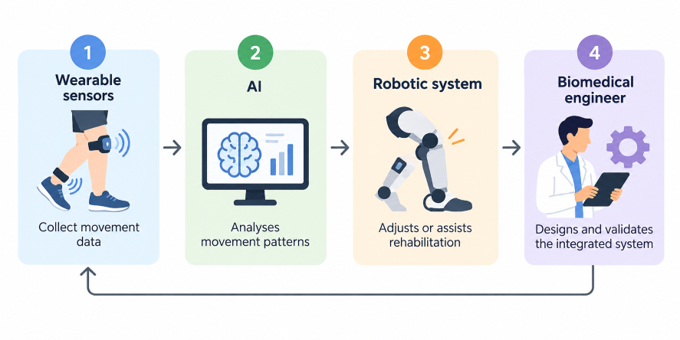
AI + Robotics + Wearables
For example, a patient recovering from a movement-related condition may use rehabilitation wearables to track movement patterns and monitor progress. When combined with professional assessment, this information may help healthcare teams tailor rehabilitation plans.
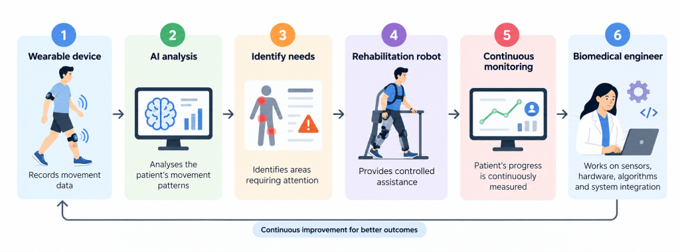
5. Implantable and BioMEMS Technologies
BioMEMS, or biomedical microelectromechanical systems, refers to the fusion of miniature engineering elements with medical applications. Potential applications include:
- Biosensors
- Implantable monitoring
- Drug delivery
- Microfluidics
- Diagnostics
- Neurostimulation
This area brings together:
Biomedical engineering + electronics + microfabrication + materials + biology
BioMEMS technologies combine biomedical engineering with electronics, microfabrication, materials science and biological sciences to develop compact systems for sensing, diagnosis, monitoring and selected therapeutic applications.
Their design requires careful consideration of device size, material compatibility, measurement accuracy, reliability and safety, particularly when devices are intended for implantation or direct contact with biological tissues.
6. Digital Twins and Computational Modelling
Computational models are increasingly being used to represent real-world systems. This can support:
- Simulation
- Medical-device development
- Treatment planning
- Personalised modelling
- Process optimisation
- Predictive analysis
This helps biomedical engineers move from physical trial-and-error to digital modelling systems where resource wastage is reduced.
Computational modelling and digital simulation can help engineers evaluate designs, explore different scenarios and identify potential problems before physical testing. These methods may reduce development time and resource use, although experimental validation remains essential.
7. 3D Printing and Regenerative Technologies
Three-dimensional (3D) printing enables the fabrication of customised structures and components for selected biomedical applications. Its uses include:
- Custom prosthetics
- Anatomical models
- Surgical planning
- Custom implants
- Tissue-engineering scaffolds
- Bioprinting research
Regenerative medicine is another area where engineering and biology intersect. Work in this area may require knowledge of computer-aided design (CAD), biomaterials, tissue engineering, manufacturing methods and biological evaluation, depending on the application.
8. Neuroengineering and Brain-Computer Interfaces
It is among the most exceptional biomedical engineering innovations. It involves connecting directly with the nervous system and can involve:
- Brain-computer interfaces
- Neural sensors
- Neuroprosthetics
- Neuromodulation
- Assistive communication technologies
This improves the scope of neural research and provides extensive data for the development of new assistive technologies.
Biomedical Engineering Applications in Diagnostics and Treatment
|
Diagnostics |
Treatment |
|---|---|
|
AI-assisted medical imaging |
Robotics-assisted surgery |
|
Biosensors |
Rehabilitation robotics |
|
Lab-on-chip systems |
Smart prosthetics |
|
Molecular diagnostics |
Implantable therapeutic and monitoring systems |
|
Wearable monitoring diagnostics |
Drug-delivery technologies |
|
Point-of-care diagnostics devices |
Tissue-engineering solutions |
What Skills Will Future Biomedical Engineers Need?
Future biomedical engineers need a combination of biomedical knowledge, engineering fundamentals, computational skills and professional judgement. The specific skills required will depend on their chosen specialisation and the type of healthcare technology they intend to develop.
|
Biomedical knowledge |
Engineering |
Computational |
Emerging technology |
Professional |
|---|---|---|---|---|
|
Human anatomy |
Electronics |
Python |
Robotics |
Research |
|
Physiology |
Instrumentation |
MATLAB |
Wearable sensors |
Problem-solving |
|
Biology |
Mechanical design |
Data analysis |
BioMEMS |
Communication |
|
Biochemistry |
Signal processing |
Machine learning |
3D printing |
Documentation |
|
Biomaterials |
Control systems |
Image processing |
Medical imaging |
Teamwork |
|
|
Embedded systems |
Computer vision |
Artificial intelligence |
Regulatory awareness |
|
|
Modelling and simulation |
Digital health |
Ethical decision-making |
How Can Students Prepare for a Career in Biomedical Engineering?
Students interested in biomedical engineering should build a strong foundation in relevant engineering and biological sciences, subject to the eligibility and curriculum requirements of their chosen programme. They can strengthen their preparation through laboratory work, engineering design projects, programming, data analysis, internships and interdisciplinary research. When evaluating a programme, students should consider its curriculum, laboratory facilities, practical learning opportunities, faculty expertise and exposure to relevant healthcare technologies.
Biomedical Engineering Career Opportunities
Biomedical engineering offers opportunities across medical-device development, healthcare technology, research, rehabilitation, digital health and related fields. The roles available to graduates depend on their academic qualifications, technical skills, practical experience and the requirements of the employer.
|
Career area |
What professionals may work on |
Illustrative Roles |
|---|---|---|
|
Medical devices |
Designing and testing healthcare devices |
Biomedical Engineer, Design Engineer |
|
Biomedical instrumentation |
Sensors, monitoring systems and instruments |
Biomedical Engineer, Design Engineer |
|
Medical imaging |
Imaging systems, image processing and AI |
Imaging Systems Engineer, Image Processing Specialist |
|
Rehabilitation engineering |
Prosthetics, exoskeletons and rehabilitation devices |
Rehabilitation Engineer |
|
Robotics |
Surgical, rehabilitation and assistive robots |
Robotics Engineer |
|
Wearable technology |
Sensors and health-monitoring systems |
Wearable Technology Engineer |
|
Bioinformatics |
Biological and healthcare data |
Bioinformatics Analyst |
|
Connected healthcare technologies |
Digital Health Specialist |
|
|
Biomaterials |
Materials for implants and medical applications |
Biomaterials Researcher |
|
Clinical engineering |
Healthcare equipment and technology management |
Clinical Engineer |
|
Regulatory affairs |
Medical-device compliance and documentation |
Regulatory Affairs Associate |
|
R&D |
Development and testing of biomedical technologies |
Research Assistant, R&D Engineer |
Why Clinical Understanding Matters
Biomedical technologies must address real clinical needs while meeting appropriate standards of safety, reliability and usability. Biomedical engineers therefore need to understand the intended users, clinical environment and practical requirements of the technologies they develop. Collaboration with healthcare professionals can help ensure that engineering solutions are appropriate for patient care. Technical innovation must be supported by testing, validation and responsible decision-making.
What Challenges Could Slow the Adoption of These Technologies?
- Data privacy: Wearables and connected medical devices may collect sensitive health information, making data privacy, informed consent, secure storage and appropriate data governance important considerations.
- Data quality: AI systems may produce biased or unreliable results when training data are incomplete, unrepresentative, or insufficiently validated.
- AI bias: AI can misproduce if training data is incomplete or unrepresentative
- Regulatory requirements: Appropriate testing, validation, and regulatory approval are mandatory.
- Cybersecurity: Connected medical devices can introduce additional cybersecurity risks.
- Interoperability: Different systems need to work together for efficiency.
- Cost and accessibility: These might be initially expensive and difficult to deploy.
- Clinical validation and reliability: Biomedical technologies must be evaluated to establish whether they perform safely and reliably for their intended use. Promising laboratory results alone do not necessarily establish clinical effectiveness.
Conclusion
The future of biomedical engineering lies in combining engineering principles, biomedical sciences and emerging technologies to address real healthcare needs. Artificial intelligence, robotics, wearable devices, computational modelling and advanced manufacturing are creating new possibilities in diagnosis, treatment, monitoring and rehabilitation. This would require biomedical professionals to develop a set of various skills in designing the devices, systems, and technologies that connect engineering with patient care, alongside engineering, computational, research and problem-solving skills will be essential.
Equally important is understanding clinical requirements, patient safety and the need for reliable, validated technologies. Together, these capabilities can help prepare students to contribute to the evolving healthcare technology landscape.
